
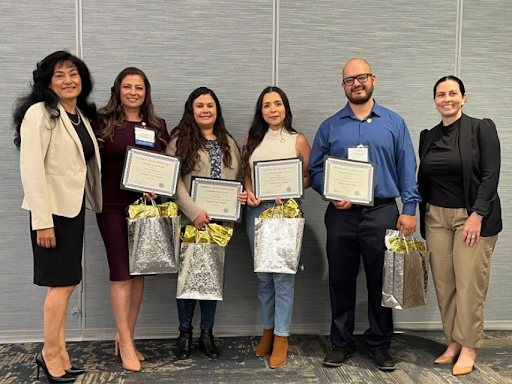
Five of the 18 CHW graduates in Orange Coast College’s first graduating class (LinkedIn)
It’s easy for families to get lost navigating our county’s complex system of services. To help make service navigation easier for families, organizations in Orange County are finding ways to integrate community health workers (CHWs) into their workforce as coaches for families with young children, or as support staff working alongside providers in clinics and hospitals.
CHWs have long been an invaluable but underutilized resource. They can support families in a number of different ways: by helping with issues like postpartum isolation and fathers experiencing loneliness, by connecting families with social services and the medical system, and by leading playgroups for babies and toddlers to teach parents and caregivers about developmental milestones and early relational health. CHWs also help parents get connected right away to the county’s larger medical system, whether it’s for vaccinations, wellness checks, treatment, or counseling.
All of that reflects the community’s vision for Family, Infant and Early Childhood Mental Health (FIECMH). Integrating CHWs and the work they do into programs that already exist is a concrete way for organizations to take direct action towards strengthening the capacity of the perinatal and postnatal workforce—Strategy 3 of the OC FIECMH Roadmap.
Across Orange County, a growing network of community organizations, nonprofits, and training programs are already helping to build this workforce. Orange Coast College’s CHW accreditation program graduated its first class in 2026. Graduates are now working with partners including MOMS Orange County, Padres Unidos, Sacred Path, and Latino Dads—facilitating parenting playgroups, supporting fathers, helping families navigate housing and financial stress, and building the early relational health that research shows shapes children’s lifelong well-being.
“There is no doubt that the Community Health Worker Role is a vital component of the overall care team continuum,” said Dr. Michael Weiss, VP of Population Health at Rady Children’s Center, a pediatric healthcare system that includes the Children’s Hospital of Orange County. “Providing culturally appropriate, evidence-informed care that connects families to their local resources is vital.”
“Capitalizing on the energy around CHW training, certification, and reimbursement facilitated through the CalAIM program and local efforts, Rady Children’s Health Orange County is working to consolidate all CHW roles across the organization to ensure a standardized approach to education, certification, outcome metrics, and billing practices,” added Weiss, who is also a health sciences clinical professor at the UC Irvine School of Medicine and a Clavis Foundation Endowed Chair for Wellness. “We are working with philanthropy as well as publicly available grant funding to bring this vision to fruition.”
Community health worker services became a Medi-Cal benefit in July 2022, which means organizations serving Medi-Cal members can now access reimbursement for CHWs. Welcoming CHWs into the workforce is a key strategy for the county because the healthcare workforce faces significant layoffs and shortages, especially in primary care. The healthcare system is also under strain due to an aging population and ongoing retirements of key health professionals, something that could damage access to care and increase wait times among patients.
The county is also seeking to support its families through services that are linguistically and culturally attuned to its residents, and CHWs can facilitate, outreach, and engage with their own communities. CHWs also support basic healthcare needs and provide connection for the whole family.
Yvette Nuñez, Health Systems and Family Resilience Program Officer for First 5 Orange County, underscores that one of the most valuable parts of the CHW program is that the health workers are from the same community as the parents.
“It’s vital to build trust with the community,” she told us. “And one of the best features of the program is that community health workers are from the same community and are so respectful of the families they serve. It creates an outstanding level of trust. The CHWs speak the same language, they share the same culture, so parents don’t feel judged. They can just sit down and have these conversations—it’s like talking with a neighbor down the street.”
After their graduation from Orange Coast College, CHWs work at nonprofits as play coaches for six-week sessions that involve snacks, talk, and play sessions with parents and their children, encouraging parent-child interactions through toys and games.
“It’s a place where we can help all families hit their milestones and grow together,” says Nuñez. First 5 OC runs the administrative hub for CHWs, including overseeing stipends from nonprofits to pay for CHW certification studies at OCC and paid work as parenting playgroup coaches when they graduate. The hub also takes care of all the payment paperwork from the nonprofits, so CHWs don’t have to worry about billing.
Besides being a lot of fun, the parenting play groups are also a strengths-based early relational health program, Nuñez points out. Parents chat and play with their children while CHWs connect ideas about social-emotional learning to the play going on around them. CHWs also help with all sorts of basic needs, she says, “whether it’s supporting moms with postpartum isolation, helping them figure out how not to fall behind on rent, and providing free diapers and wipes.”
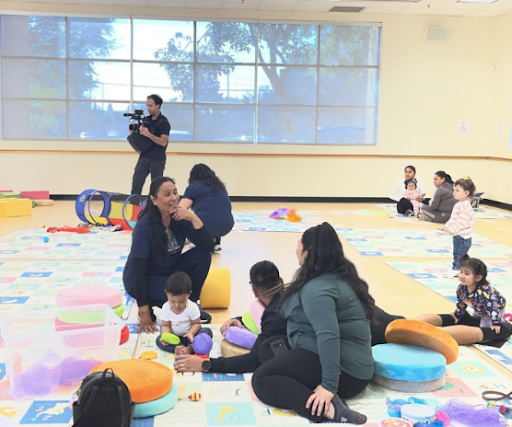
Moms talking in a CHW-run playgroup/Courtesy of First 5 Orange County
Fathers are included, too, meeting in a Fatherhood Connection group while the moms meet before joining them in the play and family sessions. Loneliness and isolation also tends to break down as parents befriend each other. “We’ve noticed that as the weeks go by, parents begin to socialize in class, then carpool together, and later we hear they’ve become friends outside of class,” says Nuñez.
In other news, the first graduates from Orange Coast College’s Community Health Workers program are now working in the field, and more CHWs are training at OCC and eager to put their newfound knowledge into action in the county. Here we share part of an interview from OCC student Alejandra Gallegos, a project specialist from Santa Ana Early Learning Initiative (SAELI)—the largest and longest-running First 5 Orange County Engaged Neighborhood group—who recently talked with OC Reports.
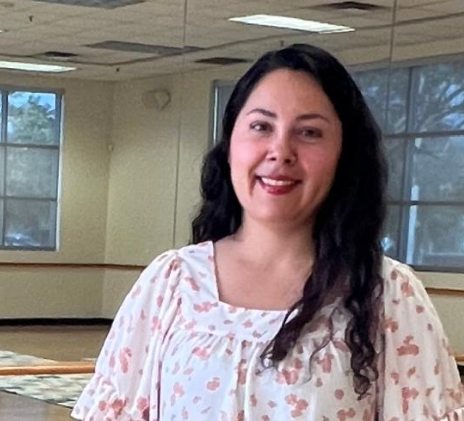
OCC student Alejandra Gallegos
“I really enjoy connecting with the community. I feel fortunate that it’s something I’m comfortable with and able to do well,” Gallegos said when asked what she enjoyed most about her job. “Understanding their culture and language helps me build those connections, and that’s what I appreciate the most. I’m grateful that they feel enough trust in me to reach out when they need help.”
She was also enthusiastic about Orange Coast College’s CHW accreditation program, which emphasizes physical and emotional wellness, health promotion, disease prevention, and cultural competency in communication. “It’s been amazing—I’ve enjoyed every second of it,” she told OC Reports. “I appreciate Dr. Georgia Halkia’s teaching style; she not only teaches theory but also shares her own experiences, which I find incredibly valuable. She makes the class inclusive, especially given that our cohort comes from diverse backgrounds. The part I’ve loved most about the program is how she draws from her own experiences—that’s what I’ve gained the most from in this course.”
This March, Orange Coast College held its 2026 Community Health Worker Regional Workforce Summit: Scaling Up Together. The event brought together CHWs, promotores, students, and educators, as well as community organizations, health care providers, and public health professionals. The summit included seminars on capacity-building, a discussion with regional experts, and the premiere showing of a video about California’s CHW vision, followed by a panel discussion.
Among the attendees was Cambodian-American CHW Phirak Loth, who shared his experiences supporting clients—“highlighting the importance of trust-building, culturally responsive care, and helping community members navigate complex healthcare systems,” wrote attendees from The Cambodian Family, a community nonprofit in Santa Ana, on Facebook.
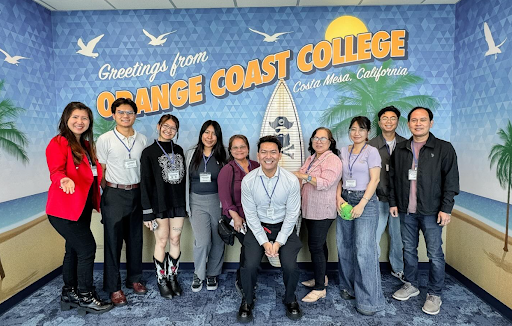
Members of The Cambodian Family nonprofit at the CHW Summit, March 28, 2026
With OCC’s graduating class of multilingual community health workers and many more in the wings; schools, clinics, nonprofits, hospitals and public health professionals should consider bringing them into their workplaces. As The Lancet has written, available health services “often lack cultural and linguistic responsiveness. Community-based specialists, including community health workers, are uniquely positioned to help seal the gaps in care that marginalized communities, including immigrants, face when interacting with health-care systems.”
To learn about the Medi-Cal CHW benefit: CA DHCS Community Health Workers page